Coupled systems
If lighting, tonemapping and materials are one system, fanning them out to three parallel builders produces regressions nothing here prevents — or detects. Give coupled work a single owner: if it is unclear, one piece.
02 / The methodVersion 4.5
The best round. Not the last one.
A build loop where the champion only moves on a blind win. The Gauntlet Loop with a memory. What you ship is the champion, by round id and commit SHA — not the working tree.
A stronger method has to earn its cost
The goal is better delivered work under the same resource limit as Gauntlet: independently checked improvements, preserved accepted versions, and fewer human decisions. More activity is not the outcome.
Evidence status: Gauntlet won the only controlled short comparison. The current method and Relay beta still need a repeated, equal-budget comparison. What would establish an improvement.
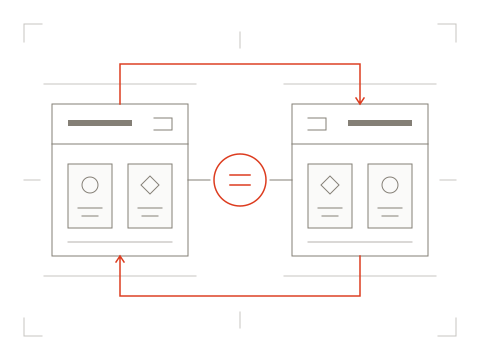
Three loops. What differs between them is how many attempts a round and what you ship — not one piled on the next, because the dearer loop is not the cheaper one with more bolted on. Pick how you would rather read it — the two views say the same thing.
Build something. Hand it to a fresh critic that has never seen your work and does not know you made it, together with a real example of what good looks like. The critic says which is better and names the single biggest thing wrong. You fix that one thing. Repeat until the critic picks yours.
It is simple and cheap and it works. It has one hole: it hands you whatever it built last — even if round 3 was better than round 6.
The same build, critique, fix loop, and two things the Gauntlet has no way to do.
It keeps a champion. Each new attempt must beat the current best in a blind head-to-head. Judges see both versions unlabelled, do not know which is which, and are checked beforehand on examples with known answers so you know they can tell good from bad at all. Lose, and the attempt is thrown away and the champion stands. So you ship the best round, not the last one.
It tracks where nobody has been. It lists the situations your thing can get into — opened with the keyboard, opened with the mouse, empty, overloaded, after an error, after a reset — and records which ones have actually been tried. Each round it sends the critic into the least-visited ones.
And the best one is kept properly, which is the most useful thing on this page. Each time an attempt wins, that version is frozen — copied aside with the exact commit it came from — and one line is added to a log that is never rewritten. So what you would ship is complete at the end of every round: stop the run in the middle of round 11 and you get exactly what a run that declared itself done at round 11 would have handed you. Work in an unfinished round can be lost; the previous accepted checkpoint remains available.
The champion, the log and the coverage map are already in the Duel. What this adds is three builders on the same problem instead of two, each told to take a different direction and none of them seeing the others. They face each other first, in a run-off judged the same blind way, and only the winner is allowed to challenge the champion.
Trying one idea a round is a search with a population of one: the best thing it can reach is whatever the first attempt happened to be. This is the cheapest way to widen that — about half a Gauntlet round more than the Duel — and what it buys is more directions tried per gap, not more re-testing. The tool picks it when your brief names more than about three separate parts, and you should know what that is worth: no measurement compares it with the Duel. The long, many-part runs it was built for have never been measured, and what ends a run is the same in both.
All three loops spawn the critic with the same words, and they are the two that do the most work in the whole method:
“You are a really harsh critic. INSPECT THE ACTUAL RENDERED ARTIFACT — run it, open it, measure it — NEVER THE BUILDER’S SUMMARY OF IT.”
Your own goal goes in next, word for word, so the standard the critic is hard about is yours and not a generic one. A critic that reports on a description has reported on nothing, and a polite one costs you the round you paid for.
And it is handed your artifact and the bar together, unlabelled — not told which is which — and asked which is better. That matters more than it sounds: every other verdict in the loop compares the run to itself. The duel is this round against the last one, and where you supply no list of criteria the run writes that too. Without the bar in the critic’s hands, a loop can only climb away from wherever it started. It cannot find out that it started in the wrong place. Winning that pick is not an ending — it means the next gap is a smaller one, and nothing else.
A big job is cut into pieces, and each piece is built and judged on its own. The cut is made once, before any building, and never changed while the run is going.
If it is unclear, one piece. One piece that could have been three is only slower, and the log shows you that. Three that should have been one breaks where they meet — every piece fine on its own, and what broke is the join nobody owns — and that is the mistake nothing here catches later. So take the error you can see.
A run ends the moment the agent stops calling tools — nothing in it is a clock. So a run that writes a tidy progress note and goes quiet has stopped, and from outside that is indistinguishable from one still working. Three real runs ended that way with the job half done. So the rule is: while there is work open, the next thing it produces is the next piece of work, not a report about the last one.
There is exactly one ending the run is allowed to declare, and it is your cap — the round count or the money you set. Everything else is keep going: a round that lost, a check that failed, a round where nothing worth judging got built, a gap it cannot close, a critic with nothing to say this time. Each of those is written down, set aside, and the run takes the next gap.
There is no word in the prompt for “I have finished”, and that absence is deliberate. Supplying one supplies the excuse. Every early stop anyone has measured came out of a word earlier versions handed over: one run declared itself finished across three rounds in which it built nothing, one stopped at a round number it took out of a warning telling it not to, one said it had run out of time when nothing in a run measures time. Those reported early stops motivate the continuation rule; they are not a complete account of every possible failure.
Two things end a session rather than the run, and neither is a question to you: the tools cannot run the loop at all, which is proved in the first minute rather than discovered in the fourth hour; or the session runs out of memory, in which case it writes a handover and the next session picks the run up where it stood. You can stop it yourself at any moment and take the champion. And whenever it does stop, the reason is written to a file before the paragraph you read, so you can tell a deliberate pause from a crash without asking it.
Against the plain Gauntlet, honestly:
And the honest part. We ran this method against the plain Gauntlet on a small three-round job. Gauntlet won: same quality, a fraction of the cost. That measurement is why Duel is the default — it is the part that did the work. The cost section below has the numbers, including the ones that go against it.
Gauntlet
You ship the last thing built
Hole the last round might not be the best one
Duel default
You ship the champion — the best round, whenever it happened
Where coverage paid a live defect in a state nobody had entered · a run that voided its own premature stop. The six-round run that missed a round-0 bug through five critics had no coverage — that is the miss it exists to catch
Why it matters what you would ship is complete at the end of every round — stopped mid-round-11, you get what a run that declared itself done at 11 would have handed you
Ratchet
What it buys more directions tried per gap, not more re-testing and not a different ending — about half a Gauntlet round more than the Duel
Not a superset the champion, the log and the coverage map are already in the Duel, and no measurement compares it with the Duel — the long, many-part runs it was built for have never been measured
The critic, in every tier
Carrying your own goal, word for word, so the bar it is hard about is yours
Why it matters every other verdict in the loop compares the run to itself. This is the one place something outside it gets a vote — and winning the pick is not an ending
Cutting it into pieces
Why that way one piece that could have been three is only slower · three that should have been one breaks where they meet, and a wrong cut is the mistake nothing here catches later
How it stops
One ending your cap — the round count or the money you set. Then two that end a session and not the run: the tools cannot run the loop at all, proved in the first minute · a session that runs out of memory hands over to the next session, never to you. And you can stop it yourself
The tax it does not remove a fresh session re-reads before it can work — measured resumes ran 2h00m and then 24m32s for that reason — and the handover shortens that rather than removing it
Not endings a round that lost · a check that failed · a round with nothing worth judging · a critic with nothing this time · a gap it cannot close — all written down, set aside, next gap. There is no word in the prompt for “I have finished”, because supplying one supplies the excuse
| Property | Gauntlet | Duel | Ratchet |
|---|---|---|---|
| Judged by | one harsh critic | 4 screened judges, blind | 4 screened judges, blind |
| You ship | the last round | the best round | the best round |
| Attempts per round | 1 | 2 | 3 |
| Untried situations | invisible | tracked, and worked | tracked, and worked |
| If you stop it mid-run | you get the last build | you get the champion, frozen by commit | you get the champion, frozen by commit |
| Cost per round (estimated, not measured) | 1× | ~2.5–3× | ~3–3.5× |
| Champion, log, coverage | none of them | all three | all three, already in the Duel |
| Use it when | short and cheap | most of the time | a gap worth three directions — never measured against the Duel |
Everything below is the detail behind the summary above — the exact rules, the numbers, and the reasoning. You do not need it to use the tool.
The composition is ours. Almost none of the parts are. Goal and inspectable bar, the builder/harsh-critic split and blind A/B come from Matt Shumer’s Gauntlet Loop. Named / Fetchable / Comparable is robonuggets. Champion/challenger promotion — ship the best checkpoint, not the last — is standard evaluation practice. Judging the work before you see it, swapping the presentation order, and spreading a panel across model families all come from the judge-bias literature.
Four attributions were settled against his three published texts. His: the rule that coupled things stay under one owner, which comes from his repo’s process note and carries his own numbers — six parallel agents over three rounds moved the score +0.46 while the worst defects ended higher than they started, 60 → 47 → 66, against +1.00 and 66 → 26 for one sequential pass with a single owner. Ours: “a pick, never a score”, which no text of his says and his own run did not follow — he picked and scored, 3.59 → 4.14 → 4.05 → 5.05 out of ten; the ban on inventing helper scaffolding, which is the community’s and ours; the progress page’s specification, where his text says not to over-specify it; and delivering the best artifact rather than the last, which his method does not address at all. And the smoothing pass between waves is optional in his article, so the Gauntlet tier calls it optional too; this method runs it every wave, and that choice is ours, not his.
The generator’s Gauntlet tier is a documented adaptation. Its setup, safety guidance and optional supplied-check feedback are additions, even when they do not gate a round. A research comparison against Shumer’s original must pin the original source and disclose the minimum harness adaptation rather than calling the generator output byte-identical to it.
gauntlet/. Three per round, each taking a different direction at the same gap, none seeing the others.Five roles, and no agent both proposes and ratifies. An agent that built both sides knows which is which, so separating the hands that build from the eyes that judge is what makes “blind” true rather than nominal.
Straight from the Gauntlet Loop, and the load-bearing part. A bar must be Named (a specific thing, not a category), Fetchable (the critic can open, run, read or measure it), and Comparable (both can sit side by side and a judge can pick one). Name a measurable half alongside it — a number, a benchmark, a budget, a pass rate. Taste plus a number beats taste alone, and a bar you cannot obtain is one you will hallucinate.
The criterion list is given, not derived: one criterion per line, each with the measurement that decides it. Setup copies it verbatim and hashes it into the first log line. It is created once and immutable thereafter, and that is enforced rather than asked for: the boundary hook lets the list be written once and refuses every write to it from the moment it exists — every tool, every shell. Keep it short; 8–15 criteria is a working range.
A criterion the run believes is wrong is a note, not a stop and not a question. It writes what is wrong with it on the log and keeps running against the list as written. If your brief carries no list at all, writing one is round zero’s first task — waiting for a human who has been told to walk away is how a run delivers nothing.
The champion on disk does not move until the challenger wins the duel. Round 0 runs no duel — there is nothing yet to beat. One piece per round: pieces never share a round, so a lost duel has exactly one owner, and they are assembled at the end by one smoothing pass and a final duel against the previous whole. Coherence comes before promote because promote is the step that appends the round’s line to the log, and a pass that runs after the append has no line left to write on.
Two orders make the promises true. Your check runs straight after the build, on every candidate worth judging, before any judge sees any of them, so “before any judge sees it” is literally the case. And the critique now runs last, on the champion: on the challenger if it was promoted, on the incumbent if it was not — so the next round’s work is always named against the version you would actually ship.
Which piece the next round belongs to is decided by the logs, not by the critic — the piece with the fewest rounds behind it, ties to whichever has gone longest without a promotion. Otherwise one part with a talkative critic takes every round and the rest ship at whatever the first round gave them, which reads as progress in the log.
If it is unclear, one piece. The two mistakes do not cost the same. A piece that could have been three is slower, and the log shows you exactly that. Three that should have been one produces the regressions this method admits nothing here catches: every piece green on its own criteria, and what broke is the interaction no piece owns — learned from a duel, late, or never. Prefer the mistake that is visible.
The cut is written on the first log line and carried forward unchanged, because a session that resumes this run did not make the call and cannot re-derive it.
The one mechanism here with a cited catch to its name, and it targets the class neither a critic nor a duel reaches. Two misses are what it exists to catch, and both were measured on runs that had no coverage — neither was a judgement failure:
And where a run had it, it paid, twice. A live defect sat in a state no round had entered until coverage sent a critic there; and a run that had already declared itself finished voided its own stop when the map turned up a state nobody had tried. Those are the catches. The two misses above are the motive, and quoting one of them as a catch would be selling a mechanism on the failure that argued for it.
A critic told to find the biggest gap looks where it expects one, and six critics expect the same place. So round 0 writes a state map: for each criterion, the states it speaks about, crossed against three axes — entry path (keyboard, pointer, programmatic, restored), data state (empty, typical, at the limit, over it, invalid) and sequence (fresh, after an action, after a reset, after an error). Crossed, because both misses above were crossings. The map is append-only, not frozen — the standard is fixed but the territory grows, and a deleted state is one that stops being uncovered.
Every critic and every judge reports the states it entered, with evidence it got there. Each round the three least-visited states go into the critic’s instructions, by name, and it has to enter them and say what it found. It costs no extra agents.
Coverage is not quality and is never scored. It says somebody looked, not that the artifact is good there. The moment it becomes a number to maximise, a builder will enter states cheaply to raise it.
Each round spawns three builders on the same gap, in three separate worktrees, each told to take a different direction and to say in one line which direction it took. None sees the others. Sampling once per round is a search with a population of one: the best artifact reachable is whatever the first attempt happened to be. Not thirty, because the filter here is a blind panel rather than a machine, and every extra sample costs judges.
Every builder is handed four things, written out in full: the gap as the critic named it, the criteria that bear on it copied word for word, the measurement that is failing, and the bar itself — your reference files, by absolute path. The builder is the only agent in the method that changes the artifact, and the references are kept out of its checkout so it cannot grade itself against them — so it is handed them by path, or it would never see what good looks like.
And a builder does not return on a commit. It returns when it has run the thing it built, driven it into the state the gap names, captured that state, and put the capture beside your reference — and if they do not match it goes again, up to three times, before it hands anything back. It reports the commit, the direction in one line, and the path of its last capture. A builder that never ran what it built has produced a diff, not a challenger, and in a real run three of them came back in about fifteen minutes each with one file apiece, after which every gate in the round spent its money choosing between things nobody had run.
Each candidate is ruled material or no-op first, from its diff against the champion, and a no-op is not a challenger. Without that the round can never fail: a near-no-op inherits the champion’s behaviour, ties every criterion, and the cheapest promotion in the method becomes a change that improves nothing measurable. If all three are no-ops, the same assignment is re-issued and the log says so.
If more than one is material, they go to a champion-free selection duel — the run-off — first: two judges, one per presentation order, no screening pack, ruled against the frozen criterion list and nothing else, and the winner alone reaches the champion duel. A selection win is not a promotion. And selection judges may not be the duel’s judges: a judge that ruled here has seen the challenger and can name it on sight in an unlabelled slate.
Its slates follow the champion duel’s rule too: every candidate is driven into the state the gap names and captured there, the same interaction on each. Two attempts at one gap differ in exactly one place, and a slate that does not show that place is two identical-looking pictures and a coin toss. Round 0 runs the same selection duel as every other round. A selection panel is never “seated”, because there is no pack to seat it on: the log records how many judges it asked and how many answered, and fewer than two answers means the run-off did not happen — the lowest-numbered candidate goes forward and the line says it went by default.
Both halves, in the spawn text and in the contract, in every tier:
“You are a really harsh critic. INSPECT THE ACTUAL RENDERED ARTIFACT — run it, open it, measure it — NEVER THE BUILDER’S SUMMARY OF IT. What was asked for is: …”
What follows is your own goal, verbatim, so the standard the critic is harsh about is yours rather than a generic one. These are the Gauntlet Loop’s own words, and they are the cheapest mechanism in the method.
And it goes all the way through before it names anything. It plays the whole game, reads the whole document, uses the whole tool — whatever the thing is, it experiences all of it in one sitting the way you would, and reaches the end. A critic that judged the first screen has judged the first screen. It says in one line how far it got and what it did to get there, and if it could not reach the end, that is the gap.
Your artifact and the bar have to be the same kind of thing, or the blinding is decoration. Whatever form your reference is in — screenshots, a served page, a document — ours is rendered into that same form, at the same size, in the same state, before the critic sees either. A running app beside a folder of stills is labelled by its format, and a critic that can tell which is which is not blind however carefully the names were stripped. Where the two cannot be matched, the critic still gets both and the log records that the pick was not blind, because a pick you know was not blind is worth less than one you thought was.
And that pick steers, or it is decoration too. If the last three rounds all picked the reference over ours, the loop has lost three times running on three different gaps — that is a distance problem, not a gap-finding problem. So the next round is assigned the criterion the critic cited against us most often across those three rounds, whatever else it named. It is the one judgement in the method that comes from outside the run, so it has a route into what the run does next.
The checks you supplied run against every candidate worth judging, each from its own clean checkout, immediately after the build and before any judge sees any of them. A binding one failing takes that candidate out of the round; if it takes all of them, the gap is set aside. They are machine-checkable and they are yours, so they are not a matter of taste and they do not go to a duel. If your brief carried none, Gate 1 is empty and that is the deal the run took — it says so in the log rather than inventing a suite.
Round zero is the exception: the starter version must first describe its runnable
interface in run.json before the sealed checks can use it. Record that baseline
honestly; it is not a duel-proven improvement.
Running your check first is what keeps a failing candidate away from every judge. It costs up to two more clean checkouts on a three-candidate round and nothing else: a checkout is not an agent call, and the agents are the whole bill.
This loop writes no checks of its own. Your sealed check is the only suite, and the duel decides every promotion. The cost section has the measurements behind that.
The Preparer builds both candidates from clean checkouts at identical settings, takes every capture, strips provenance and hands out shuffled unlabelled slates. A judge handed one side built and the other described is not comparing artifacts.
Normalise the evidence packaging, not the quality being judged. Match viewport, input, timing, and anonymous labels. Preserve the artifact’s layout, typography, interaction, and wording whenever a criterion evaluates them. Equalising those would remove the very improvement the judges need to see. Style bias moves judges more than position bias does, so this is the higher-leverage debias and it is free. Then record what the normaliser left, because an unmeasured normaliser is a style confound you paid for and did not collect.
One rubric, frozen, shared by all four judges — not one each, because a 3-of-4 vote taken against four rubrics is four different questions counted as one. It adds no criteria, removes none, softens none, and says only where to look. It is derived once, after round 0’s candidates exist, from the criterion list and those real candidates: a rubric written with no artifact in front of it comes out generic, and a generic rubric measurably makes judges worse than no rubric at all.
Judges commit first: before opening any candidate, each writes down what a winner must show, per criterion, because a judge shown a candidate first scores plausibility instead of correctness. Criterion order is randomised, and each criterion is ruled A / B / TIE with a citation — the exact output, measurement or capture that decides it. No citable evidence is not a pass. No scores out of anything, ever: a pick between two things stays honest as the artifact improves and a number does not. Pairwise judging being steadier than scoring is well supported.
Four calibrated judges, two per presentation order. A promotion needs at least three judges who prefer the challenger or call it a tie, with a strict preference for the challenger in both presentation orders. One favourable vote and three ties are insufficient. Three of four for the champion discards; anything else is a tie, and a tie promotes nothing. The builder receives the lost criteria and their cited evidence.
Four ties is not a win. Neither is a single strict vote surrounded by ties.
The kit’s adjudicate.mjs validates the panel record and computes the
verdict without a model doing the arithmetic. Invalid records cannot promote. It checks
the evidence structure, not whether a cited capture actually proves the claim; that still
requires independent inspection.
Accepted does not mean infallible. Judges can miss regressions or disagree about a trade-off. Binding checks remain separate from preference votes, and a frozen champion is the strongest version this run accepted, not proof that every property only improved.
Spread the panel across models, not only across orders — across vendors, and where the harness offers three or more, neither judge vendor is the builder’s; elsewhere the builder’s own model is excluded and the shared vendor is recorded — a related judge prefers its relative through style fingerprints that blinding does not remove. Honestly, that is a small correction: judges built alike make the same mistakes, so a panel from one family is worth fewer independent votes than its headcount, and mixing families buys error tolerance rather than independence. It is nearly free, so take it. Where a harness offers one model, the run records that and a unanimous verdict counts for less.
Four rather than two, because the arithmetic decides it: with two judges a genuinely better challenger is blocked whenever either errs — at an assumed per-judge error rate of 0.2, which nobody has measured, that is about a third of real improvements. And record the margin per judge — criteria won and lost. Not a score on the artifact: without it, a comfortable 4–0 and a 4–0 where every judge was one criterion from flipping are the same log line.
On a split, escalate once only when a valid tied panel contains both challenger and incumbent preferences. All ties, invalid evidence, and one-order-only support without dissent do not trigger another panel. Use different eligible judges, freshly calibrated, and its verdict stands; a second split remains a tie. Log both panels. Never escalate a loss: repeated chances to get a preferred answer bias the result.
Before the live comparison, the same judge rates a separate pack of task-matched controls that contains neither live candidate. A resumed judge remembers its calibration: using the champion there can reveal its identity in the live duel even if labels are shuffled. The control is a candidate round 0 discarded, a sibling of the first champion pinned by commit, or the bar where round 0 left none; the pack is built once per rubric version, with one alternate for a respawned judge. Ten items, of which only nine count. The answer key remains hidden from the judge.
A judge is seated on 8 of those 9, a screening threshold rather than a measured accuracy guarantee. The controls share an artifact, criteria, and model, so they are not independent trials from which to infer a reliable accuracy bound. Transform only properties that the criteria treat as irrelevant: reformatting a design or paraphrasing a copywriting task may change quality and is not automatically an equal control. Fail the pack and the verdict is void; respawns are capped at two per duel with freshly drawn valid controls.
If fewer than nine of the last ten duels seated a full panel, the criteria are not judgeable as written — and as written is the rubric, which is an instrument and the loop’s own. It rewrites the rubric once, sharpening what the failed packs died on, and carries on. That is a repair, not an ending: a panel that still cannot be seated sets the gap aside like any other difficulty.
Two-phase, and the order is the point. Write a PENDING marker, perform
every write, freeze the challenger as the new champion with its commit and a fresh checksum,
append the log line, and only then delete the marker. Delete-then-append leaves a window
where the marker is gone and the files disagree with the last log line — exactly the
state this rule exists to stop being read as tampering.
A champion folder no log line names is an orphan, not a fault. A promotion that died between the freeze and the log line leaves one behind; nothing under the run’s folder can be deleted, so it is recorded and never read as the champion. The log names the champion, and only the log. The run also says in its report when it thinks one of your checks is wrong.
Three of seven real runs died for lack of this rule, and the two that survived had invented it on their own. The orchestrator had spawned its judges or critics, waited on all of them at once, and one never came back — so the run sat for most of a day burning tokens at the healthy rate, looking alive, doing nothing. Which method the run was using had nothing to do with it.
Every child gets a deadline when it is spawned — three times the median of that phase over the last three rounds, read off the log, and ninety minutes until there are three. The run collects one child per call, each wait bounded by ten minutes or the deadline, in a loop, writing a log line after every return; never a list, and never a turn ended while a child is open. A child past its deadline is dead, not late: token burn and a live process are not evidence, because the runs that died had both. It is stopped, respawned once with a fresh context, and if that dies too the role’s fallback takes over — a dead builder means the round runs on the survivors, a dead critic means the coverage map picks the assignment, a dead preparer means no duel this round, a dead judge means the quorum below. A third dead child ends the round — two are survivable, and a dead judge plus its dead respawn is exactly the quorum case — past that the gap is parked and the next round takes the next gap, because a round that keeps spawning into a call that keeps killing children is the hang wearing a loop.
Quorum. With exactly three judges seated and both presentation orders still present, a win needs no seated judge preferring the champion and a strict challenger preference in both orders — a no-dissent rule on a smaller panel has fewer vetoes and is easier to win, and the order condition pays that back. Fewer than three, or an empty order, is a panel that did not seat: no promotion, next round.
Nothing in a piece’s round can see the join between two pieces that each did the right thing. So at the end of every scheduling sweep — when every piece has had a round, whether it won or lost — a fresh critic experiences the assembled champions end to end, never a diff and never a summary, and names the single biggest seam. That seam is the owning piece’s next assignment. It moves no champion and runs no duel: it steers. Shumer’s article calls this pass optional; this method runs it as a critic, one agent call per wave, and says that the choice is ours. With one piece there is no separate pass, because there are no seams between pieces and the ordinary critic already goes through the whole thing end to end.
The only part of this method that is not the loop grading its own proxy. The run runs them every round, edits them never and reads them never. Half of that is enforced and half is trust, and the run is told which: the hook denies writes to the check bodies from every caller, but running a check means reading it, so not reading them is a rule the run keeps rather than a control that holds it. If it reads one anyway, it says so in the log and in its final report. That disclosure is the whole of the control on this half.
Every kit also ships a handful of floors nobody has to choose — no logged errors, the same behaviour twice, keyboard reachable, no third-party calls, and never slower or heavier than round 0 made it. Anything that cannot apply to your artifact is declared in writing, for you to disagree with.
Two prerequisites with no fallback: a real browser, and an address the artifact is
served at — file:// is refused. Without either, every check answers
unrunnable, which is a suite gating on nothing and reporting success.
Unrunnable is not a pass, and whose fault it is decides the round — measured, not
judged: the same check is re-run against the champion. Unrunnable on the challenger alone is
the artifact, and it fails the round. Unrunnable on both is your environment, and it fails
nothing — it is a hole in the standard, reported every round until it is filled.
Which checks can fail a round is written in each check’s own criterion file, and the index that ships beside them agrees. Nothing else decides it, and the run may not assign it.
One scenario you wrote is worth more than every derived threshold together, because it is the only part of the method that samples your judgement rather than the loop’s reading of your prose. A real run held a physics invariant to four decimal places — 7.3431 s against a sealed 7.34 s ± 2% — every round. And what “sealed” means is narrow: untracked, hook-denied, absent from a builder’s checkout. Nothing here is cryptographic. The value is that the standard was fixed before the run started, by something other than the run.
“Builders may not read gauntlet/” is an instruction, and
instructions are not controls. Without enforcement every anti-gaming claim above is
decoration. Four things carry the weight:
gauntlet/. A path that is not there cannot be read, and it needs no hook.This is crash consistency, not tamper-proofing. The checksum lives inside the tree it hashes, so an agent with write access could rewrite both consistently and nothing here would notice. Real tamper-evidence needs a hash chain kept outside the run’s writable tree. If you need that, build it — do not assume this gives it to you.
It runs on two harnesses today: Claude Code, with a supported level selected through
/effort in a clean session and Ultracode off, and Grok Build, started with
/goal <objective> --budget N once goal mode is on (goal.enabled).
On Grok Build, project hooks and AGENTS.md are silently skipped
until the folder is trusted — so trust it with /hooks-trust (or start with
--trust), then confirm with grok inspect rather than assuming. A /goal completes only once an
independent review reproduces the claim; where it cannot, the goal pauses and names the gaps,
and /goal resume continues it.
Installation details change across releases. The builder role requests a worktree, but setup must inspect the actual tool schema and verify where the child ran; a copied argument is not proof of isolation. For clean archives, create the destination directory before extraction and verify it contains the committed artifact. Keep observed behavior scoped to the installation that produced it, rather than turning one old failure into a universal CLI rule.
The rest of the harness detail — which flags, which hook file, what each CLI silently
skips, how spawning and isolation really behave — is in RATCHET-LOOP.md,
which the generator ships unmodified in the run kit beside the hook and the exact
prompt for your brief. That is the operating manual; this page is the explanation.
| Run property | Grok Build | Claude Code |
|---|---|---|
| Ordinary run | Project AGENTS.md, Grok hooks, goal-mode hand-off | Project CLAUDE.md, Claude settings and role files |
| Coding model | Choose a supported installed model; record its resolved identifier and effort. A display name is not a CLI identifier. | |
| Judge identity | Read harness metadata where available. Record same-family, two-model or single-model limitations instead of treating self-report as proof. | |
| Before spending | Verify project trust, actual tool schemas, builder isolation, completion collection, and hook denial. Keep checks local to the intended project. | |
| Supervised beta | Relay, fresh headless session per round | Use the ordinary kit; a Claude supervisor is not verified here |
| A 4.4 lineage on a newer CLI | On grok 1.0.50, apply the 4.4 field patch first: on grok 1.0.50 that kit’s hook fails open under Windows PowerShell and its builders’ commits land outside your repository | Finish it under its own kit |
A new model does not require a new method name. It does require a recorded change in the run conditions. Keep your running kit intact and start a separate lineage to compare another model or these updated rules.
The champion, named by its round id and commit SHA. Not the working tree. Not the last thing built. And it is restored to the working tree as part of landing — if the last round lost, the tree holds the loser while the champion sits where nobody thinks to look, and that looks like success until someone diffs it.
You get the champion round and its commit, your sealed verdicts, coverage as entered and never entered, the duel record, the calibration pass rate, the children that died, and the log.
For several pieces, a collection of piece champions is not a verified whole. Identify the assembled commit and its integration evidence explicitly. Keep a prior verified whole available if assembly fails or the budget cannot pay for validation; otherwise disclose that only piece-level checkpoints were verified. Prefer one lineage for coupled work rather than promising integration the run never tested.
There is one ending the run may declare, and it is your cap. Where you named a number of rounds or an amount of money, that number halts the run — and it stops before the round that would cross it rather than during one, because a round that runs out halfway leaves no verdict and nothing promoted. Where you set none, none was meant, and the run is told it may not invent one.
Everything else is keep going. A check that failed, a duel lost, a round where nothing material got built, a panel that could not be seated, a state nobody could enter, a critic with no gap to name — each is written down, set aside, and the run takes the next gap the critic named. A gap set aside is not a solved gap and the log says so.
And the attempts at a gap are counted on the log, not remembered. The count is 1 the round a gap is first assigned and one more on every later round that assigns the same gap, whatever the verdict; at three, the gap is set aside whether or not anyone called it blocked. Two rounds that could not move it are difficulty; a third is the run paying to guess at the same thing again. A count kept only in the session’s head is gone the next time it compacts, so the log keeps it.
And there is no word in the prompt for “I have finished”. That absence is deliberate, and it has more evidence behind it than any other rule here. Every early stop anyone has measured came out of a vocabulary earlier versions supplied: a run that declared itself converged over three rounds in which it built nothing and ran no duel; a run that stopped at a round number it had taken out of this document’s own cautionary example, while its author had left the cap blank; a run that reported it had “run out of time” when nothing in a run measures time; a run that stopped to ask permission for an action it had just proved correct. Supplying the word supplies the excuse.
A stop preserves the last accepted checkpoint, not the unfinished round. The champion is frozen by commit with a log line every round, so the deliverable is complete at every round boundary: a run killed in the middle of round eleven ships exactly what a run that decided it was done at eleven would ship. The run ends when your cap fires, or when the harness or the session kills it, and in all three the champion on disk is the answer — but a low context is not a kill: after a compaction the run reads its resume block and starts the next round. Every round boundary therefore writes three things and they are not optional: the log line, the champion round and commit on it, and the handover rewritten.
A run that asks a question has failed, however good its reasoning was. A run that pauses because a session ended has not. The one exception that ends a run is an integrity fault: the record disagrees with itself, so nothing written after it can be checked by anybody and there is nothing you could answer. It writes what changed, delivers the last champion whose checksum still matches, and stops.
Everything else is difficulty, and difficulty does not end a run. A judgement call about the artifact is yours; a judgement call about how to keep working is the run’s. Ending a thirty-round run at round eleven because one gap was blocked forfeits nineteen rounds a plain Gauntlet run would have spent improving something else. That, and not any gate, is how this method loses to the loop it improves on.
A turn ends when the agent stops calling tools, so a report written instead of the next action is a stopped run that reads like a working one — and three real runs ended that way with an assignment still open, no pause recorded, and a human who could not tell any of them from a crashed process. So every boundary has a defined next act: a build ends and the candidates are ruled material or no-op; a duel settles and the next duel or the decision it feeds follows; a round ends, the log line is appended, the handover is rewritten, and the next round starts.
And never a request that you approve a next action the run has already worked out. If it has named the action, it is the one that runs it. If what it is about to hand back ends in a question mark, it has not finished. And a turn that does end writes the log line first — disk before prose, always, because you tell paused deliberately from stopped talking by reading the last line, and a summary in a chat window is not a state.
Landing early because a session might end spends the whole remaining run to avoid a cost nobody measured. If a session truly cannot carry on, it pauses at a round boundary and never mid-round, with the handover written and true. A pause ends the session, not the run, and it is addressed to the next session rather than to you.
The handover is rewritten at every round boundary, not only when a run decides to pause, because sessions that end mostly do not get to choose. It carries the round to start, the champion and its commit, the standard in force, the open gap and every direction already tried on it and how each died, coverage and the gaps set aside, and what is still on disk to clean up. A resuming session reads that and the last log line and nothing else historical; where the two disagree the log wins.
And the clean-up line is rewritten the moment anything removable exists — each worktree, each checkout, each server with its port and process id, as they are made rather than when the round ends. A round that dies in the middle is the only case that line is for, and it is the one case a rewrite at the boundary cannot cover.
Measured, which is why it is worth the two minutes. Real sessions of this method ran 8h41m, 8h00m and 8h42m; the resumes after them ran 2h00m and 24m32s, each shorter than the last because a fresh session spends its first hour re-reading before it can work. Nothing written in a prompt makes a session bigger — what the handover does is make that re-read a page. Closing this properly is external automation’s job, not the prompt’s.
Multiples are against one plain Gauntlet round (1×, itself unmeasured), and they are estimated from what a round spawns, not measured: the Duel runs ~2.5–3×, the Ratchet ~3–3.5×.
| Round type | What it spends | Multiple |
|---|---|---|
| Nothing promoted | Three builds, a clean checkout per candidate for your check, up to two selection duels on two uncalibrated judges each, two cold clean builds for the champion duel, four judges and four ten-item calibration packs | ~3× |
| Promoting | The same, plus freezing the champion and re-preparing | ~3.5× |
| Split → escalation | One more panel, drawn differently, freshly calibrated | +~1.5× |
| Nothing material built | No duel spent, the same assignment re-issued | ~1.5× |
Judges are the whole bill, and the lever is how many rounds you buy, not how many judges are in one. Do not drop the champion duel to two judges: two is this method’s own definition of a panel that did not seat, so the round has no verdict and the two judges bought nothing. Do not economise by skipping calibration either — an uncalibrated panel is not a cheaper gate, it is no gate. If cost is the binding constraint, run fewer rounds, or run the plain Gauntlet rather than running this badly.
Gate 1 costs a clean checkout per candidate, up to three a round. The multiples above leave it out, because a checkout is not an agent call and agent calls are the bill.
Set a hard budget before you start. Runs of this shape still reach hundreds of dollars.
Reaching your cap delivers the current champion and stops. You are the brake. On Grok
Build the ordinary run reads reported usage through its supported goal facilities. The
Claude interactive kit uses a status-line command that writes session-identified estimated
USD cost to gauntlet/cost.json. A new session resets its own counter, not the
run’s spend. Missing readings stay unknown. Claude’s separate print-mode
--max-budget-usd flag is not an interactive budget control. Estimates may differ
from billed cost, and a round may exceed a boundary prediction; use provider-side limits too.
These are the measurements that took the self-written regression suite out of the method (the version history below has the before and after), kept here because the evidence that removes a mechanism is worth more than the mechanism was.
The head-to-head this method lost. Both loops, one brief, three rounds, the same ten-criterion bar, cost disregarded. This method took 5.7× the wall clock and 8.7× the agent calls, and a blind panel of four judges across two model families preferred the plain Gauntlet’s artifact or tied it — none preferred ours. Its regression suite caught nothing: six challengers, ten mutation-validated checks, zero regressions, both promotions decided by the duel.
The hardest number anyone has on this method, and it goes against it. Two lineages were re-measured afterwards by a harness neither loop wrote: this method’s three champions, and six rounds of a plain build/critique loop on a deliberately coupled artifact — movement, collision, an inventory, a carry limit, a derived score, save/load and a HUD, all depending on each other, built with no regression protection whatsoever. Eight round-to-round transitions. Zero regressions. Not one probe that passed at round N failed at round N+1. With the head-to-head’s six challenger checks that is fourteen checks and zero events. Only the eight transitions were independently re-measured; the six challenger checks are a different observation, not six more transitions. This small sample does not establish that regressions cannot happen on longer runs.
The same run is also why the method is worth having at all: each loop shipped a real defect the other caught. The duel found page text illegible behind the palette’s own scrim and drove it from 1.65:1 to 8.53:1; the plain Gauntlet shipped that defect at 3.25:1. The plain Gauntlet’s critic found focus stranding on a backdrop click; this method shipped that one. The duel and the critic see different things, which is why both are still here.
The counter-argument, which is not weak. Every one of those measurements was taken where this method already said it does not pay — one piece, three rounds, six-round lineages. The conditions the re-testing was designed for — thirty rounds, five parallel pieces, sessions that get replaced — have never been measured. A reasonable person can say it has not failed its test; it has not been given one. It is recorded rather than accepted for three reasons: it was carried for eleven revisions and grew to about half the prompt while waiting for its conditions; prompt size was then the direct input to the only stop that had killed runs (the later deaths were a wait on a list, and contexts have since grown, so 4.5 stops mandating a read of the specification); and a mechanism never exercised is not protection, it is an untested claim. The honest experiment is a long coupled run, not another rule.
The honest scoreboard: the plain Gauntlet won the only controlled comparison this
method has been given, at a length where the method itself says it does not pay. Since then
seven multi-day runs produced a great deal about which runs live and die and nothing that
compares finished artifacts — three methods, two models, one brief, and the arms never
finished together. So nobody can yet say this loop builds a better thing than the
Gauntlet. What can be said: once the waiting rule existed it did not die more often; its runs
resume from disk where the Gauntlet’s cannot; and it found the class of defect six fresh
critics could not. Two things it does not claim: it cannot tell you it is finished, on purpose,
and it runs one piece-round at a time where the Gauntlet lets its lead agent choose concurrency —
one branch point, one run.json, one cap on children make parallel pieces a race.
The comparison starts with the same brief, starting commit, bar, builder model, effort setting, and resource ceiling in both methods, tested separately on Grok Build and Claude Code. Equal round counts are not equal compute: Ratchet spends more inside a round. Fix the dollar or time budget before starting, keep every failed attempt and restart in the result, and repeat across more than one brief. A model change is a separate condition, not a method improvement.
Evaluate the delivered commits with a fresh external panel, unlabelled artifacts, both presentation orders, and the same observable criteria. Keep quality, cost, wall time, human decisions, and regressions as separate results. The run’s own promotion rate measures its decisions, not the quality of the final artifact.
The protocol and read-only measurement tool live in tools/experiment/ in the
project repository.
The tool reads both round ledgers and Relay session records, keeps missing readings unknown,
and reports incomplete spend separately. No paid head-to-head was run for this release.
The method is designed to improve the outcome; superiority remains a result to measure.
If lighting, tonemapping and materials are one system, fanning them out to three parallel builders produces regressions nothing here prevents — or detects. Give coupled work a single owner: if it is unclear, one piece.
This is what the method gives up, stated plainly. Protection against a round-thirty regression on a five-piece brief is real in principle, was never once exercised by any measurement, and cost about four fifths of the prompt.
The one hand-back no wording removes. The handover makes the re-read a page rather than a run; it does not remove the tax. Closing it needs a supervisor outside the prompt — which is what Relay, the beta edition for Grok Build, is.
Still the number one failure. Every gate here makes a bad bar expensive as well as useless.
A champion that only moves on a blind win cannot descend, and some redesigns need one bad round on the way. Reaching those is your decision, not the loop’s.
The critic will invent a standard. Front-load a planning pass that produces a pass/fail answer key first, and use that as the bar. And note: this detects accidents, not adversaries.
What changed, newest first, and why. The specification in the run kit carries the full notes.
run.json to redirect it.adjudicate.mjs.SEAL_ROOT), so a green no longer risks grading the champion twice.SEAL_URL.From the method to your project